Boost Mobile Chirp Phones played a major role in shaping the push-to-talk mobile phone era in the United States. Long before smartphones dominated communication, these rugged and instantly responsive devices were the go-to choice for construction crews, delivery drivers, and anyone who needed fast, reliable communication.
In this complete guide, we’ll explore boost mobile chirp phones, their history, popular models, features, advantages, limitations, and whether they still make sense in today’s mobile landscape. By the end, you’ll have a clear understanding of why Chirp phones became iconic—and what replaced them.
What Are Boost Mobile Chirp Phones?
Boost Mobile Chirp Phones were mobile devices that used push-to-talk (PTT) technology, branded as Chirp, allowing users to communicate instantly with the press of a button.
Instead of dialing a number and waiting for a call to connect, users could simply press the Chirp button and talk—similar to a walkie-talkie, but powered by a nationwide cellular network.
Key Characteristics of Boost Mobile Chirp Phones
- Instant push-to-talk communication
- Operated on the iDEN network
- Loud front-facing speakers
- Durable, work-friendly designs
- No contracts with prepaid plans
This combination made boost mobile chirp phones especially popular among professionals and younger users seeking fast, social communication.
The History of Boost Mobile Chirp Phones
Understanding the legacy of boost mobile chirp phones requires a look at the evolution of push-to-talk technology.
Early Beginnings: Nextel & iDEN
The technology behind Chirp phones originated with Nextel, which operated on the iDEN (Integrated Digital Enhanced Network) platform. iDEN was designed specifically to support instant communication.
Boost Mobile later adopted this technology, making it available on prepaid plans—a major innovation at the time.
Boost Mobile Enters the Market
When Boost Mobile launched in the early 2000s, it targeted:
- Younger demographics
- Urban users
- Blue-collar industries
Boost Mobile Chirp Phones quickly became a cultural phenomenon, especially in cities.
Peak Popularity (2004–2010)
During this era, boost mobile chirp phones dominated:
- Construction sites
- Warehouses
- Transportation industries
- Youth and street culture
The iconic “Where You At?” Chirp sound became instantly recognizable.
Decline of Chirp Technology
The decline began when:
- Smartphones gained popularity
- LTE and 4G networks replaced iDEN
- Sprint (which acquired Nextel) shut down the iDEN network in 2013
Once iDEN was retired, boost mobile chirp phones were officially discontinued.
How Boost Mobile Chirp Phones Worked
Boost Mobile Chirp Phones operated differently from modern smartphones.
Push-to-Talk Explained
- User presses the Chirp button
- Phone connects instantly to another Chirp user
- Voice is transmitted in real time
- Release button to listen
This system eliminated call setup delays.
Network Technology
- iDEN network (not GSM or CDMA)
- Optimized for low-latency voice
- Limited data capabilities
While excellent for voice, the network struggled with modern internet demands.
Popular Boost Mobile Chirp Phone Models
Over the years, Boost Mobile released several iconic Chirp phones. Below are the most memorable models.
Motorola iDEN Series (Most Popular)
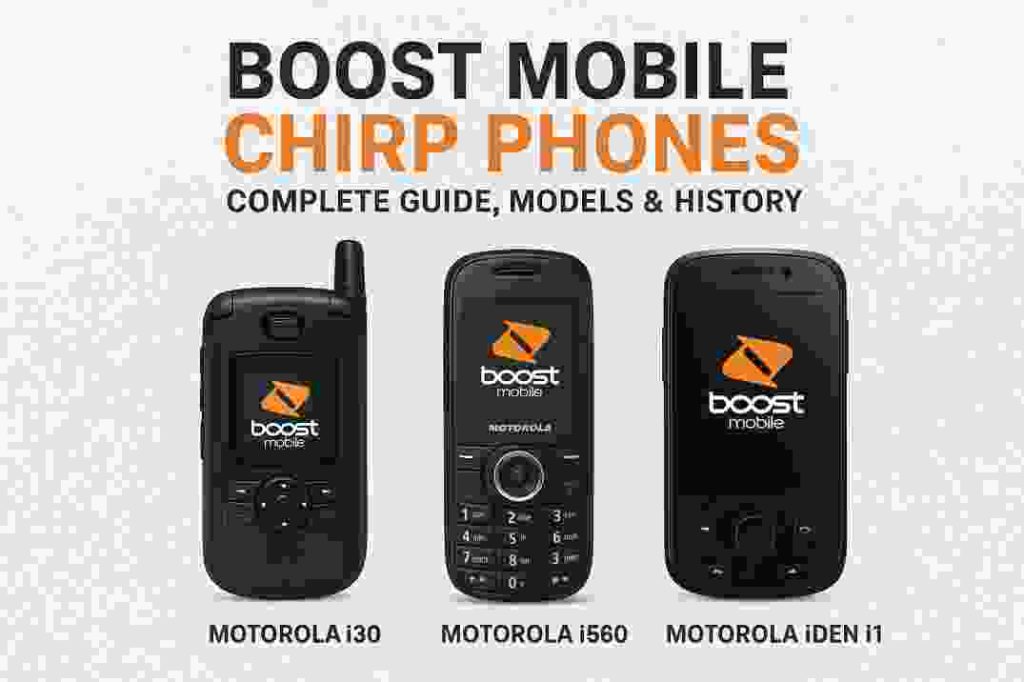
Motorola manufactured nearly all boost mobile chirp phones.
Motorola i425
- Entry-level Chirp phone
- Compact and affordable
- Ideal for basic communication
Motorola i530
- Rugged, military-grade durability
- Water-resistant design
- Popular with construction workers
Motorola i560
- Slimmer design
- Bluetooth support
- Improved battery life
Motorola i880
- Camera phone
- MicroSD card support
- Multimedia features
Motorola iDEN i1 (Android-Based)
- Android OS (rare hybrid)
- Touchscreen
- Last major Chirp phone released
Why Boost Mobile Chirp Phones Were So Popular
Boost Mobile Chirp Phones didn’t become successful by accident.
Key Advantages
- Instant communication – No dialing or ringing
- Affordable prepaid plans – No contracts
- Durable hardware – Built for tough environments
- Group communication – Perfect for teams
Cultural Impact
Boost mobile chirp phones became symbols of:
- Street culture
- Youth independence
- Workforce efficiency
They even appeared in music videos, movies, and pop culture.
Boost Mobile Chirp Phones vs Smartphones
Let’s compare boost mobile chirp phones with modern smartphones.
Chirp Phones Pros
- Faster voice communication
- Simple interface
- Long battery life
- Excellent call clarity
Chirp Phones Cons
- No modern apps
- Slow or nonexistent internet
- Limited multimedia features
- Network discontinued
Smartphones ultimately replaced Chirp phones due to their versatility.
What Replaced Boost Mobile Chirp Phones?
After iDEN shutdown, Boost Mobile transitioned to modern technologies.
Modern Alternatives
- Sprint Direct Connect (PTT)
- AT&T Enhanced Push-to-Talk
- Zello (App-Based PTT)
- Microsoft Teams Walkie Talkie
These services replicate Chirp functionality using LTE and 5G networks.
Are Boost Mobile Chirp Phones Still Available?
Can You Still Buy Them?
- New: ❌ No
- Used: ⚠️ Collectors only
- Network support: ❌ Discontinued
Even if you find a used device, it will not function on modern networks.
Should You Consider a Chirp Alternative Today?
If you liked boost mobile chirp phone, modern PTT apps are your best option.
Best Modern Use Cases
- Construction teams
- Event staff
- Security teams
- Delivery services
Most modern solutions offer:
- Group chats
- GPS tracking
- Cloud management
- Cross-platform support
Boost Mobile Chirp Phones: Pros & Cons Summary
Pros
- Legendary instant communication
- Simple, rugged devices
- Affordable prepaid access
Cons
- Obsolete network
- No longer supported
- Limited modern functionality
Internal & External Linking Suggestions
Internal Links
- Anchor: Boost Mobile prepaid plans
- Anchor: Push-to-talk phone alternatives
External Links
- Motorola official site (history reference)
- Boost Mobile official website
Frequently Asked Questions (FAQs)
❓ What were Boost Mobile Chirp Phones used for?
Boost Mobile Chirp Phone were mainly used for instant communication via push-to-talk, especially in work environments and social groups.
❓ Do Boost Mobile Chirp Phones still work?
No, boost mobile chirp phone no longer work because the iDEN network was shut down.
❓ Can I still buy a Boost Mobile Chirp Phone?
You may find used models online, but they cannot connect to any active network.
❓ What is the modern replacement for Chirp phones?
Modern replacements include push-to-talk apps like Zello and carrier-based PTT services.
❓ Why were Chirp phones discontinued?
They were discontinued due to outdated network technology and the rise of smartphones and LTE networks.
Final Thoughts on Boost Mobile Chirp Phones
Boost Mobile Chirp Phone were revolutionary devices that changed how people communicated. Their instant push-to-talk feature, rugged design, and prepaid accessibility made them iconic in mobile history.
While boost mobile chirp phone are no longer supported, their influence lives on through modern push-to-talk solutions. For those who experienced the Chirp era, it remains a nostalgic reminder of a simpler, faster way to connect.
If you found this guide helpful, share it on social media, leave a comment below, or explore more mobile history content to keep learning.
About the Author