German mobile phone numbers follow a specific structure within Germany’s telephone numbering plan. Each number consists of three parts: the country code (+49), a mobile network prefix, and the subscriber number. The Federal Network Agency (Bundesnetzagentur) oversees this plan, and it assigns Germany the country code +49. For domestic calls within Germany, a leading 0 (trunk prefix) is added before the prefix (e.g. 0151 instead of +49 151). Understanding these components is crucial for writing and dialing German mobile numbers correctly.
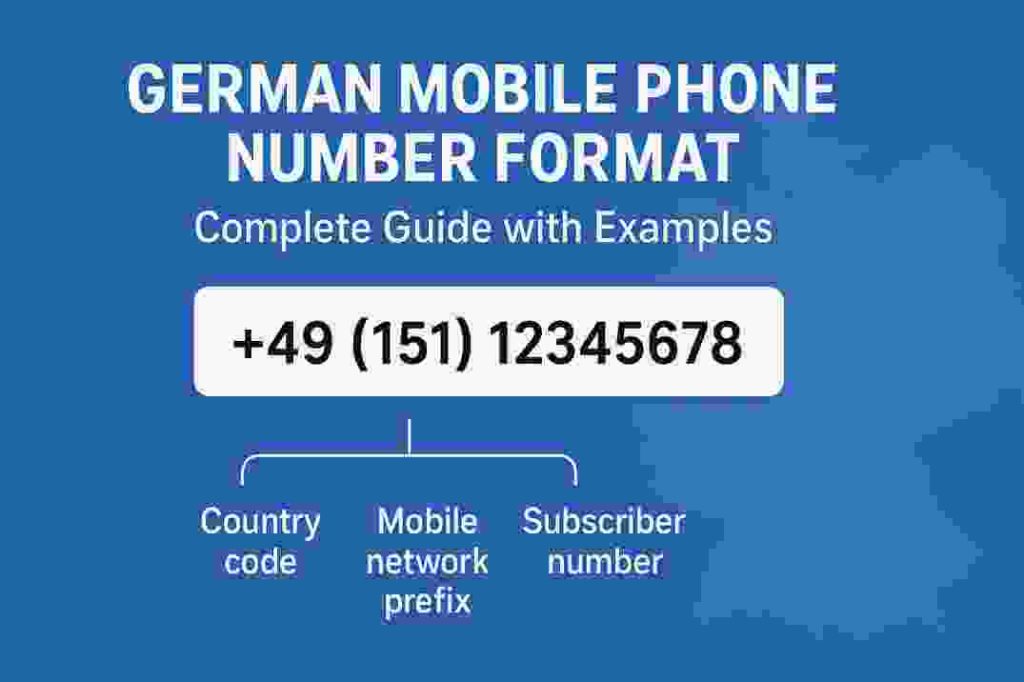
- Country Code (+49): +49 is Germany’s international dialing code. When calling a German number from abroad, dial the international exit code (often 00 or +) followed by 49.
- Trunk Prefix (0): Within Germany, phone numbers begin with a leading 0 in place of +49. For example, +49 1522 3433333 is written as 01522 3433333 domestically.
- Mobile Network Prefix: German mobile numbers always start with 15x, 16x, or 17x. These non-geographic prefixes (like 0151, 0160, 0172, etc.) were originally allocated to carriers. (Today number portability means a prefix no longer guarantees a specific operator.)
- Subscriber Number: The remaining digits (usually 7–8 digits) are unique to the subscriber’s line. When combined with the prefix, German mobiles typically have 10 or 11 total digits (excluding the 0). For example, 0151 12345678 (10 digits) or 0176 123456789 (11 digits) are common lengths.
This breakdown shows a German mobile number might look like +49 (151) 12345678 (international) or 0151 12345678 (domestic). The next sections explain formatting and dialing rules in detail.
Structure of German Mobile Phone Numbers
German numbers use an open numbering plan where area and subscriber lengths can vary. Mobile numbers start with 15x, 16x, or 17x (the digit “1” signals special/service prefixes). For example, prefixes in the 15x range include 151, 152, 155, etc.; the 17x range includes 170–179. The mobile prefix identifies the original network (e.g. 151 = Telekom, 152 = Vodafone, 160 = Telekom, 162 = Vodafone, 170–171 = Telekom, 172–174 = Vodafone, 176 = O₂). However, thanks to mobile number portability, you cannot rely on the prefix to know the current carrier.
When written together (international format), a German mobile number looks like:
+49 (prefix) (subscriber number)
For instance:
- International: +49 (151) 12345678
- Domestic: 0151 12345678
Here +49 is the country code, 151 is the mobile network prefix, and 12345678 is the subscriber number. In practice, parentheses around the prefix are often omitted, yielding +49 151 12345678 or 0151 12345678.
Domestic vs. International Format
When dialing a German mobile number, you must choose the correct format based on your location:
- From within Germany: Dial 0 + prefix + subscriber.
- Example: To call (0151) 12345678 from a German phone, simply dial 0151 12345678.
- From abroad: Dial the international exit code (usually 00 or +) + 49 + mobile prefix without the 0 + subscriber.
- Example: To call the same number from outside Germany (e.g. USA or UK), dial +49 151 12345678 or 011 49 151 12345678.
The key is to drop the leading 0 when using +49.
- Example: To call the same number from outside Germany (e.g. USA or UK), dial +49 151 12345678 or 011 49 151 12345678.
For clarity, here is a comparison:
- Domestic format: 0 152 1234567 (leading 0 included)
- International format: +49 152 1234567 (leading 0 replaced by +49)
Example: +49 1522 3433333 (international) is the same as 01522 3433333 (domestic).
Length and Examples
German mobile numbers (excluding the country code) are usually 10 or 11 digits long. Most 16x and 17x prefixes have 10-digit numbers, while 15x prefixes often have 11 digits. For example:
- +49 151 12345678 (prefix 151 + 8-digit subscriber = 11 digits).
- +49 176 1234567 (prefix 176 + 7-digit subscriber = 10 digits).
Some sample formats:
- Berlin mobile: +49 152 1234567 (domestic: 0152 1234567)
- Munich mobile: +49 176 2345678 (domestic: 0176 2345678)
- Generic example: +49 157 7654321 (domestic: 0157 7654321).
Each part can be separated by spaces or parentheses for readability (e.g. +49 151 12345678). According to German style (DIN 5008) and international E.123, it’s common to write +49 1522 343333 with spaces. Without country code, it might appear as (01522) 343333. In any case, keep the trunk-0 or +49 at the front depending on the format you use.
Common Mobile Prefixes
Germany uses many mobile prefixes. Some common examples include:
- 0151 – originally Telekom (T-Mobile).
- 0152 – Vodafone’s block.
- 0160 – originally Telekom (T-Mobile).
- 0170, 0171 – originally Telekom (T-Mobile) blocks.
- 0172–0174 – originally Vodafone blocks.
- 0175 – originally Telekom (T-Mobile).
- 0176, 0179 – originally O₂/Telefónica blocks.
Each “15x”, “16x”, or “17x” prefix spans all of Germany, not a specific region. Because of number portability, a number’s prefix may no longer reflect its current carrier. In other words, while historically 0151 was T-Mobile, that 0151 number could now be on a different network.
Dialing Rules
Here are the steps to dial German mobile numbers:
- Dialing within Germany: Always dial 0 + prefix + subscriber. For example:
- To call 0176 2345678 from a German phone, just dial 0176 2345678.
- To call 0152 1234567, dial 0152 1234567.
- Dialing from abroad:
- Dial your country’s international exit code (such as 00 or in the USA 011, or simply use “+”).
- Then dial 49 (Germany’s country code) and omit the 0 of the prefix.
- Finally, dial the mobile prefix and subscriber number.
- Example: To call 0176 2345678 from the US, dial 011 49 176 2345678 (or +49 176 2345678).
- Checking the format: If uncertain, many smartphones will automatically add the correct country code for international contacts. Ensure the number is saved with +49 for best results when traveling or switching SIM cards.
By following these rules, your call will connect correctly. Forgetting to replace the 0 with +49 is the most common mistake for international callers.
Formatting Guidelines and Best Practices
For clarity and compatibility (especially in international contexts or CRM systems), follow these formatting tips:
- International Style: Always start with +49 when writing the number for international use. E.g. +49 152 1234567.
- No Extra Symbols for Storage: In databases or contact lists, remove spaces, brackets, or slashes. For example, use +491521234567 instead of (0152) 123-4567. Most CRM and VoIP systems work best with a clean numeric format.
- Readable Display: For user-facing text, you can include spaces or parentheses for readability, according to DIN 5008/E.123. Commonly, the country code, prefix, and subscriber number are separated by spaces:
- International display: +49 151 12345678
- National display: (0)151 12345678 or 0151 12345678.
- Confirm Digit Count: German mobiles are usually 10–11 digits long (not counting the +49). If a number is significantly shorter or longer, double-check it.
Following these guidelines will ensure your German mobile number is understood and dialed correctly.
FAQs
Q: What is Germany’s country code and trunk prefix?
A: Germany’s international country calling code is +49. Domestically, Germans dial a leading 0 (zero) before the area or mobile prefix. Thus, +49 replaces the 0 for international format.
Q: How do I dial a German mobile number from outside Germany?
A: To call a German mobile from abroad, dial your exit code (such as 00 or 011), then 49, then the mobile prefix without the 0, and then the subscriber number. For example, a German number 0176 1234567 (domestic) becomes +49 176 1234567 internationally.
Q: How many digits are German mobile numbers?
A: German mobile numbers (excluding the trunk prefix 0) are usually 10 or 11 digits long. For instance, a Telekom number might be 10 digits (e.g. 0176 1234567) while others have 11. The combined length of prefix+subscriber is 10–11 digits.
Q: Can I tell the carrier from a German mobile prefix?
A: Originally yes (e.g. 151 for Telekom, 152 for Vodafone), but due to number portability you cannot be sure of the current carrier. These days, the prefix mainly indicates it’s a mobile number, but anyone can switch networks and keep the same number.
Q: What format should I use when saving a German number on my phone?
A: Best practice is to save with the +49 country code (and no extra characters) – for example +49 152 1234567. This ensures the number is correct when traveling. You can add spaces for readability.
Conclusion
Mastering the German mobile phone number format is essential for effective communication. In this guide we covered the country code (+49), the domestic trunk prefix (0), and the mobile prefixes (15x/16x/17x) that mark German cell numbers. We showed how to write numbers in both domestic and international formats, provided examples (e.g. +49 151 12345678 vs. 0151 12345678), and explained dialing rules from home and abroad. Remember: for international use, replace the leading 0 with +49, and always double-check the digit count (10–11 digits for German mobiles).
By following these guidelines and examples, you can share and dial German cell numbers confidently. If you found this guide helpful, share it on social media or in your travel groups – and leave a comment below if you have any further questions or experiences to share about German phone numbers!
German Mobile Phone Number
About the Author