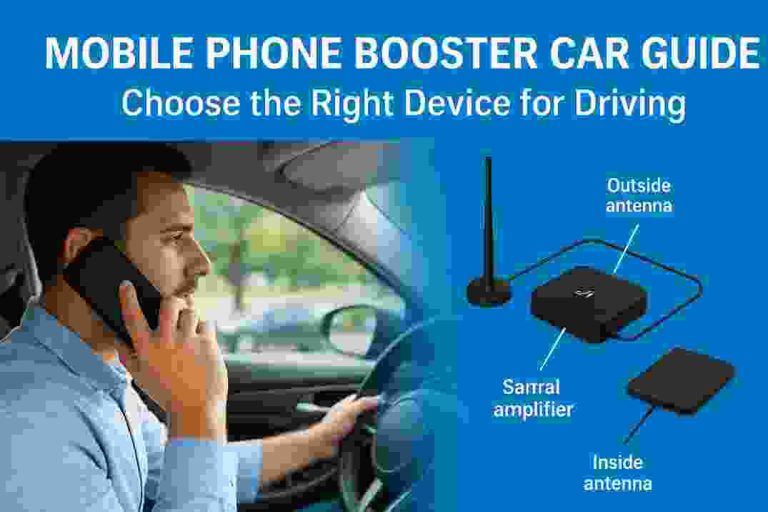
Modern RV travel often means venturing into spots where cellular coverage is weak. An RV mobile phone booster captures distant tower signals and amplifies them inside your motorhome, turning “dead zones” into usable coverage. In practice, a booster kit (see image below) uses an exterior antenna to grab the faint signal outside, a signal amplifier to boost it (often up to ~32× stronger), and an interior antenna to rebroadcast the enhanced signal inside. This process results in “faster data speeds” and “fewer dropped calls” even in remote areas. As one source explains, boosters effectively “draw in weak signals and amplify them… creating robust, reliable coverage” for all your devices.

Why You Need an RV Mobile Phone Booster
- Extended Coverage: RVers often camp in rural areas where carriers under‑serve. For example, only about 85–94% of rural Americans even have basic cellular coverage. Carriers often skip far‑flung spots because “it’s not cost-effective to build new networks” there. A booster helps fill these gaps by grabbing whatever signal is available and boosting it.
- Multi-Device Support: Today’s RVers carry phones, tablets, GPS units, and even mobile hotspots. A good RV booster serves all devices simultaneously. WeBoost notes that its RV boosters “work with all phones and cellular devices on all U.S. & Canada carriers” and support multiple users at once. This means everyone in the RV – family or friends – can surf and stream without fighting over bars.
- Improved Speed & Reliability: Even when you’re near a weak tower, a booster can dramatically improve performance. In weak-signal tests, RV users reported seeing much higher upload speeds and improved call quality with a booster. One camper said the booster made phone calls stable and even enabled streaming Prime Video where it was otherwise impossible. In general, an amplified signal translates to “better 3G, 4G LTE, [and] 5G… faster data speeds, fewer dropped calls, [and] reliable texting”.
- Peace of Mind: A booster can be a lifesaver in an emergency or for remote work. Whether checking weather apps, GPS, or contacting family, having a consistent signal is worth the investment for many RVers. (Plus, top boosters are FCC‑approved and safe to use.)
“Everyone needs to make calls, text, work remote, and shop online. Fortunately, this is where cell phone signal boosters… make all the difference”. In short, an RV mobile phone booster is a key upgrade for any long-distance traveler.
How RV Mobile Phone Boosters Work
RV boosters consist of three main parts: an exterior antenna, a signal amplifier, and an interior antenna. First, the roof-mounted exterior antenna captures the cellular signals from nearby towers. That signal is sent via cable to the amplifier unit, which boosts its strength (some systems can amplify signals by 32×). Finally, the interior (panel or whip) antenna rebroadcasts the enhanced signal inside the RV. As one manufacturer describes:
- “The outside antenna communicates back and forth with nearby cell towers. The booster amplifies any cell signal it receives from the outside antenna. The inside antenna broadcasts these signals for use throughout your vehicle.”
Put simply: Outside antenna → amplifier → inside antenna. This setup means even a faint 1‑bar signal outside can become a robust 3‑4 bars inside, giving your phone a strong, consistent connection.
Mobile vs Stationary Antennas: In motion, RV boosters use omnidirectional exterior antennas to pick up signals from any direction. These ensure you get whatever coverage is around you, even as you drive. (Omnidirectional antennas are lower‑gain, but work in any heading.) When parked, you can also use a directional Yagi or panel antenna on a mast pointed at a known tower.
This is more powerful. As one RV supplier notes, “In motion, you’ll be using some sort of omnidirectional antenna… While stationary, you’ll want to use a Yagi antenna… your best option if you spend most of your time parked”. In other words, mobile boosters usually include a small omni antenna for driving, and stationary setups use a taller directional antenna to maximize gain (up to 65–72 dB allowed).
Top RV Mobile Phone Boosters of 2025
Here are some leading RV boosters chosen for performance and reviews:
- weBoost Drive Reach RV (Mobile Booster): Widely regarded as the top mobile RV booster. It provides the maximum FCC-allowed boost for vehicles. Reviewers praise it for high power: it delivers about 26 dBm uplink, meaning “no other booster works as well as the Reach at the edges of a cellular network”. It truly boosts signals both while driving and when stopped. One RV expert notes it reaches towers “up to 74% farther away than comparable boosters.”. In short, Drive Reach RV is ideal if you’re frequently on the move and need maximum range.
- weBoost Destination RV (Stationary Booster): Best for campers who stay in one place for a while. This kit includes a 25-ft telescoping pole and directional antenna to target cell towers. It supports all carriers and both 4G/5G, boosting voice and data when parked. WeBoost explains it “instantly improves talk, text, and streaming in any stationary camper”. Importantly, it delivers up to 65 dB of gain (versus 50 dB limit on moving boosters), so it covers a larger area. (The trade-off is that it cannot be used while driving – you set it up at a campsite and point it toward the tower.) This is the go-to for long stays in weak-signal campgrounds.
- HiBoost Travel RV Boosters: HiBoost’s RV lineup (e.g. Travel 4G/5G kits) offers a budget-friendly, multi-carrier solution. These kits (Travel 2.0, 3.0, etc.) come with an omni antenna and amplify up to ~50 dB. In real-world tests, HiBoost units performed well: one RVer reported that the HiBoost Travel 4G 2.0 “allowed us to go from a very poor cell connection to a usable one” in low-signal areas. It notably improved upload speeds and call stability, even enabling video streaming at a site that had no signal before. Reviewers find the hardware sturdy and often less expensive than competitors, with handy features like a signal-monitoring app. If budget is a concern, HiBoost is worth considering.
- Other Options: There are also boosters from Wilson (the maker of weBoost) and SureCall that work well in RVs. WeBoost (Wilson) even offers a new Drive X RV variant, and Wilson sells the Destination RV via retailers. Brands like Wilson/SureCall and weBoost focus on quality and service. In general, look for an FCC-certified booster that supports all U.S. bands and multiple users. For example, weBoost’s kits emphasize that they work on “all phones & all carriers” and are “5G-ready”.
Key considerations when choosing a booster: Ensure it supports your carrier frequencies, provides enough gain (look for higher dB for rural areas), and fits your travel style (mobile vs stationary use). Also check user reviews and warranties – most top boosters include a 2-year warranty.
Installation Tips
- Mounting: Place the exterior antenna on a high point (roof) with a clear sky view. Use a short, straight mast if possible, and run the cable inside with minimal bends.
- Antenna Position: If stationary, point directional antennas toward the nearest cell tower. Use apps or the booster’s signal meter to find peak reception.
- Separation: Keep the outside and inside antennas far apart (at least 10–20 ft) to avoid oscillation. Common advice is to mount the interior antenna at the opposite end of the RV from the exterior one.
- Power: Most RV boosters run on 12V DC. Hardwiring to your RV battery (via fuse) is recommended over using a cigarette lighter plug, to avoid draining your vehicle battery when parked.
- Testing: After install, test by measuring signal bars or run a speed test. Move antennas slightly if needed to maximize bars.
Frequently Asked Questions
Q: What exactly is an RV cell phone booster?
An RV cell phone booster (also called a signal amplifier) is a device that captures the weak cellular signal outside your RV and amplifies it inside. It consists of an outside antenna, an amplifier unit, and an inside antenna. It does not create a signal on its own – it only boosts what’s already available.
Q: Do RV boosters really work?
Yes, as long as there’s some signal outside. Boosters can dramatically improve connectivity in weak-signal areas. They can extend your usable range by up to tens of miles in rural zones. Users often report better data speeds and call quality in fringe coverage spots. However, if you truly have zero signal (no tower coverage at all), a booster can’t create it.
Q: Is it hard to install an RV booster?
Most kits are designed for DIY installation. It typically involves mounting the roof antenna, running a cable inside, and connecting the amp and interior antenna. WeBoost notes many RV installs take about 30 minutes to an hour with simple instructions or app-guided videos. Beginners can follow online guides or forums for help. Some RV owners also opt for professional installation, especially for large rigs.
Q: Will a booster work with all carriers and devices?
Generally, yes. A good booster supports all major U.S. carriers (Verizon, AT&T, T-Mobile, etc.) and works with any cell-capable device (phones, tablets, hotspots). Modern boosters cover 3G/4G/5G bands. Before buying, check that the model lists the frequency bands used by your carrier. Always use an FCC-certified booster, which ensures compatibility and safety.
Q: Are cell boosters legal?
Yes – in the U.S., you can use boosters as long as they are FCC-approved. Certified boosters meet technical standards so they don’t interfere with networks. (Unapproved boosters sold illegally may cause problems.) Most major booster brands comply with FCC rules and even require you to register the device with your carrier as per the instructions.
Conclusion
An RV mobile phone booster can make all the difference between frustrating dead zones and reliable connectivity on your trips. By amplifying weak cell signals, a quality booster lets you make calls, send texts, and stream data far beyond the campfire. Whether you choose a mobile booster like the weBoost Drive Reach or a stationary setup like the weBoost Destination, you’ll gain coverage that carriers alone can’t provide. When shopping, look for multi-carrier support, sufficient gain, and easy installation. In the end, a booster is an investment in staying connected – whether working remotely, navigating, or just streaming a movie from the RV.
Have you tried an RV booster? Did it live up to expectations? Share your experiences or questions in the comments below – and feel free to share this guide with fellow RVers on social media so everyone can stay connected out on the road!
About the Author