Having a grasp of Spanish mobile phone vocabulary is invaluable for travelers, expats, or anyone communicating with Spanish speakers. Smartphones and cell phones are ubiquitous – for example, Spain had 56.1 million mobile connections (117% of its population) in 2025. In this guide, we explore Spanish for mobile phone – key words and phrases (from hardware terms like teléfono móvil to everyday texting expressions). You’ll learn vocabulary for the device itself (and its parts), useful conversational phrases for calling or texting, and even common texting abbreviations. By the end, you’ll feel confident handling phone calls, messages, and app interfaces en español.
Key Mobile Phone Vocabulary in Spanish
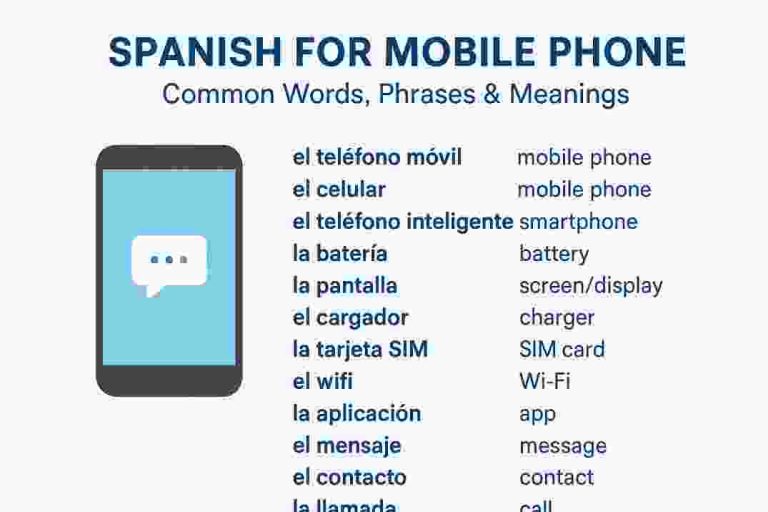
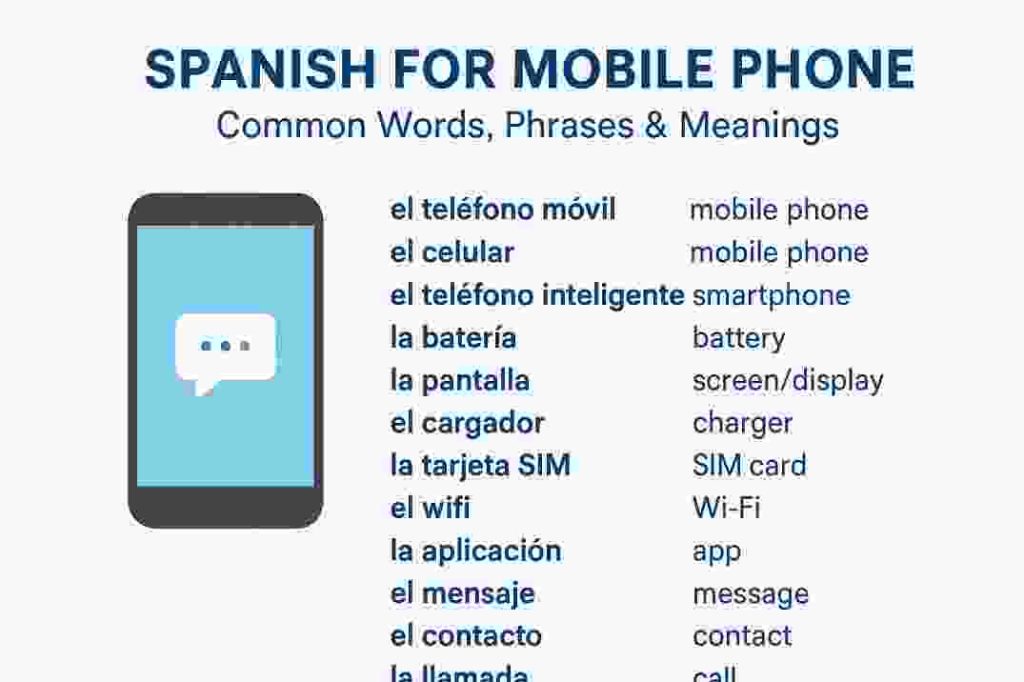
Learn the basic nouns related to phones and devices. Here are common terms English⇒Spanish (with literal meanings):
- Mobile phone – el teléfono móvil (Spain) or el celular (Latin America).
- Smartphone – el teléfono inteligente.
- Battery – la batería.
- Screen/display – la pantalla.
- Charger – el cargador.
- SIM card – la tarjeta SIM. (Note: ‘SIM’ is universal; tarjeta SIM is common in Spanish.)
- Wi-Fi – el wifi.
- App – la aplicación or simply la app.
- Message – el mensaje.
- Contact – el contacto.
- Call (noun) – la llamada. (To make a call = hacer una llamada; to call someone = llamar a alguien.)
- Signal/coverage – la cobertura or la señal (e.g. ¿Tienes señal? “Do you have signal?”).
These terms appear on menus and everyday speech. For example, if your phone dies you can say “Mi teléfono tiene la batería baja” (“My phone has low battery”). Or if you need an app, ask “¿Dónde está la aplicación?”. Knowing these words prepares you for most smartphone functions and troubleshooting dialogues. (Spanish for mobile phone often involves mixing English tech words (like wifi) with Spanish terms.)
Common Spanish Phrases for Phone Conversations
When actually using your phone in Spanish – making calls or sending messages – these phrases come in handy:
- Answering the phone: Many Spanish speakers simply say “¡Hola!” when answering. In formal situations you might hear “¿Dígame?” or “¿Diga?” (literally “Tell me”). In Latin America, “¡Aló!” is a very common answer, while in Mexico you’ll often hear “¡Bueno!”.
- Starting a call: Begin with a greeting: e.g. “Hola” or “Buenos días”. If you know who you’re calling, you might say “Hola, soy [tu nombre]” (Hi, I’m [name]). For business/formal calls: “Buenos días, mi nombre es [Nombre]” or “¿Se encuentra [Nombre]?” (“Is [Name] there?”).
- Introducing yourself: On a call, “Soy [Nombre]” (“This is [Name]”) is common. Formally: “Mi nombre es [Nombre], de [empresa]”. In informal calls, just your name is fine. For example: “Sí… ¡Hola, soy María!” as a reply to “¿Quién habla?”.
- Making a request: “Querría hablar con [Nombre]/con alguien de [departamento]” (I’d like to speak with [Name]/someone from [dept.]). To ask a question politely: “Me gustaría preguntar si…” (I’d like to ask if…) or “¿Podría pasarme a [Nombre]?” (Could you transfer me to [Name]?).
- Leaving a message: If the person isn’t there, say “¿Puedo dejar un mensaje?” (“Can I leave a message?”) or “¿Quiere dejarle un mensaje?” for taking a message. To relay a message: “Dile que llamó [tu nombre]” (“Tell him/her that [your name] called”).
- Getting back to someone: If you need to call later: “¿Te puedo llamar más tarde?” (Can I call you back later?) or “Te llamo más tarde.” (I’ll call you later). You can also say “Nos hablamos pronto” (“Talk to you soon”) or “Nos vemos” (See you).
- Thanking/ending the call: Common endings include “Gracias por llamar” (Thank you for calling), “Que tengas un buen día”, or “Fue un placer” (It was a pleasure). Informally, “¡Chau!” or “¡Nos vemos!”.
Above all, try to speak clearly and don’t hesitate to ask for repetition: “¿Puede repetir eso, por favor?” (Can you repeat that, please?). If noise or connection is bad, say “¿Me oye bien?” (Can you hear me clearly?) or “Se cortó la línea” (We got cut off). These phrases are directly useful during phone calls with Spanish speakers.
Texting Slang and Abbreviations
Spanish texting often uses informal shortcuts. Here are some tips:
- No accent marks: People usually skip ¿¡* and accent marks in casual messages. (E.g. “¿Qué tal?” might be typed as “Que tal”.)
- Common acronyms: As in English, Spanish texters use letters/initials. For example: “tqm” = “te quiero mucho” (I love you) and “ntp” = “no te preocupes” (don’t worry). Other acronyms: *“brb” isn’t used as often, but “tmb” = “también” (too/as well) and “gpi” = “gracias por invitar” (thanks for the invite).
- Skipping letters: Shorten words by dropping letters: e.g. “Amigo” → “amig” or “estás” → “tas”. People also replace sounds: “k” for “que” (e.g. “kieres” for “quieres”).
- Emoticons and emojis: Use common emoticons: “:)”, “:(”, or emojis 👍😂. Emoticon = “el emoticón”; emoji often just “emoji” or “emoticono”.
Being aware of these patterns can help you read native chats or send quick replies. For example, “luego” might appear as “q-t-al”, “xq” = “porque”, or “ksi” = “quizás”. (Note: texting slang varies by country and by age group, so when in doubt ask.)
FAQs
- Q: How do I say “mobile phone” in Spanish? A: The general term is “teléfono móvil”. In Latin America, it’s also very common to say “el celular”. For smartphone, use “teléfono inteligente” or simply “smartphone” (borrowed from English).
- Q: What’s the Spanish word for “battery” or “charger”? A: “Battery” is “la batería”. A charger is “el cargador”. E.g. “¿Dónde está mi cargador?” (“Where is my charger?”).
- Q: How do I say “my phone battery is low” in Spanish? A: You can say “Mi teléfono tiene la batería baja”. This literally means “My phone has the battery low.”
- Q: How to ask to call someone later? A: “¿Te puedo llamar más tarde?” means “Can I call you back later?” Informally, friends might say “Te llamo luego” or “Te llamo más tarde”.
- Q: How do I say “I have no signal” in Spanish? A: The phrase “No tengo señal” means “I have no signal” (literally “I don’t have signal”). If you want to ask “Do you have signal?”, you can say “¿Tienes señal?”.
- Q: What are common texting phrases like “LOL” in Spanish? A: For laughter, Spanish speakers use “jaja” or “jeje” (pronounced “ha-ha”). Some use “XD” as in English. For other slang, “tqm” = “te quiero mucho” (I love you) and “nte” = “no te entiendo” (I don’t understand you).
- Q: How to say “thank you for calling” in Spanish? A: “Gracias por llamar” is a polite way to say “Thank you for calling.” Other polite closings: “Gracias por tu tiempo” or “Que tenga un buen día”.
These FAQs highlight practical translations. For more, try looking up any unfamiliar term in a Spanish dictionary or translation app. Practice these phrases by speaking or texting them to a friend, and soon they’ll become second nature.
Engagement & Conclusion
掌掌爱 If you found this guide useful, share it with fellow learners or travelers, and leave a comment with your favorite Spanish phone phrase. Practice Spanish for mobile phone daily (for example, change your phone’s language setting to Spanish) to reinforce these terms. ¡Buena suerte! (Good luck!) With these words and phrases under your belt, you’ll handle phone calls, texts, and apps in Spanish with much more confidence.
Spanish for mobile phone
About the Author