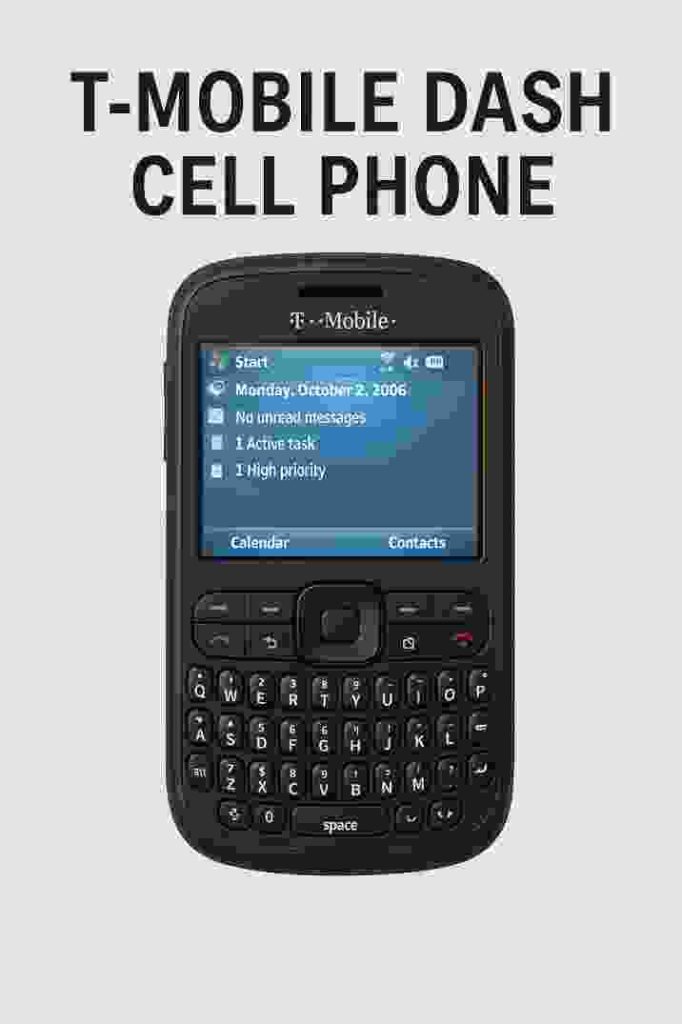
The T-Mobile Dash cell phone (HTC Excalibur) was launched in October 2006 as T-Mobile’s first thin Windows Mobile smartphone. It packed a full landscape QWERTY keyboard, Wi-Fi, and a 1.3MP camera into a slim, rounded body. Priced at $199 with a two-year contract, the Dash was touted as a “Q” killer – a more affordable rival to the Motorola Q. T-Mobile targeted it at regular consumers and families needing email on-the-go without sacrificing voice quality. Today, the Dash is remembered as a classic messaging smartphone, offering powerful features for its time in a user-friendly package.
Key Features & Specifications
- Display: 2.4-inch QVGA (320×240) TFT screen, with no touchscreen (landscape layout only).
- Keyboard: Built-in illuminated QWERTY keyboard for fast typing.
- Camera: 1.3 megapixel rear camera (capable of sharp photos for a 2006 device).
- Connectivity: Quad-band GSM (850/900/1800/1900 MHz) with EDGE data, plus Wi-Fi (802.11b/g) and Bluetooth 2.0 support.
- Operating System: Windows Mobile 5.0 Smartphone Edition (Standard); upgradeable to Windows Mobile 6.0 in 2007.
- Processor & Memory: 200 MHz TI OMAP850 CPU, 64 MB RAM and 128 MB flash storage, with a microSD slot for expansion.
- Battery: 960 mAh removable battery; up to ~5 hours of talk time and 216 hours standby (real-world tests reported ~3 days of typical use).
- Dimensions: About 4.39×2.46×0.51 inches and 4.23 ounces – very thin and lightweight for its day.
- Others: Speakerphone, vibration, stereo Bluetooth profiles (A2DP, AVRCP, etc.), no headphone jack.
These specs combine to make the Dash a well-rounded device for 2006. Below, we unpack the Dash’s design, software, performance and legacy in detail.
Design & Build Quality
The Dash is remarkably slim and ergonomic for a smartphone of its era. Reviewers noted it’s “only slightly smaller than the Q” (Motorola Q) in footprint, yet its rounded, soft-touch plastic body made it feel even more compact. Unlike boxy clam-shell phones, the Dash’s smooth edges and matte finish give a comfortable grip. Phonescoop’s hands-on found that even users with small hands could snugly hold the Dash in one hand. All edges are gently curved, and only a single side button and an easily covered charging/data port break the sleek silhouette.
Despite the small size, the Dash’s keyboard is surprisingly pleasant. The illuminated QWERTY keys are laid out in 4 rows with clear gaps between them. Reviewers report that the keys have a solid click and “feel much larger than they look”. The navigation pad and function keys sit under the right thumb (for right-handed use), making single-handed dialing or menu navigation ergonomic. Altogether, the Dash blends a modern, slim form with a classic candybar design – making it easy to carry and handle.
Display & Input
The Dash sports a 2.4-inch TFT color screen (320×240 pixels). This QVGA display shows basic graphics and Windows Mobile menus adequately, but by modern standards it’s small and low-res. Importantly, it’s a landscape display only – there is no portrait orientation or touch input on the Dash. Instead, all navigation and text entry rely on the keyboard and directional pad.
The full QWERTY keyboard is the Dash’s star feature. It’s arranged in a standard PC-style layout (QWERTY across the top row) and is always exposed – there’s no sliding or flipping action. This makes the Dash thicker than some slide phones (it’s about 0.51 inches thick) but immediately ready for typing. Because each key only supports one letter, predictive text software (T9) isn’t needed as on 12-key phones; you can spell words directly. The keyboard also works with the Windows Mobile joystick scroll wheel (the small “JOGGR” pad on the side) for smooth menu navigation without touching the screen.
Operating System & Software
Running under the hood is Windows Mobile 5.0 Smartphone Edition. This OS (from Microsoft) provides a familiar Today-screen interface and basic mobile apps for email, internet, calendar, and contacts. In late 2006, T-Mobile even offered a free upgrade to Windows Mobile 6.0 for Dash users (released in mid-2007). Thus, the Dash could be kept reasonably up-to-date with the latest Microsoft mobile software of that era.
Because it uses the Smartphone (non-touch) edition of WinMo, the Dash omits Pocket Office apps (Word/Excel viewers) and has no touchscreen – navigation is via the directional pad or the keyboard’s function keys. The Dash still supports multimedia and synchronization features: it includes ActiveSync for PC sync, a media player, and support for email push (through Microsoft Exchange or T-Mobile’s servers). Notably, T-Mobile integrated its myFaves calling plan right into the interface: up to five favorite contacts appear as icons on the Today screen for quick dialing. (According to T-Mobile, myFaves gave unlimited calling to those top five numbers.)
Overall, the Dash’s software experience is oriented toward messaging and business use, but in a stripped-down, user-friendly way. Gizmodo noted that the phone “marries a QWERTY keyboard with the Windows Mobile Smartphone edition” to cater to people who want email and web access without the complexity of a full Pocket PC.
Connectivity & Networking
For network connections, the Dash covers quad-band GSM/GPRS/EDGE (850/900/1800/1900 MHz). That means it works on any GSM network worldwide (when unlocked) and supports 2.5G data via EDGE. Importantly for wireless enthusiasts, it also has built-in Wi-Fi 802.11b/g. Early reviews praised this inclusion – TechCrunch found it surprising that such a small Windows Mobile phone had Wi-Fi at all. In practice, you could connect the Dash to a hotspot or home network for faster internet, bypassing the slower cellular data. (One demo even showed the Dash tethered to a laptop via EDGE, though Wi-Fi hotspots were recommended by T-Mobile.)
Bluetooth 2.0 is also on board, enabling wireless headsets (handsfree and stereo A2DP), car kits, or data exchange. The Dash can sync or transfer files over Bluetooth or USB cable. There is no 3G/UMTS radio on the Dash – this was purely a 2G-era phone. But for 2006 that was still common for midrange smartphones.
Key point: Wireless connectivity on the Dash is robust for its time. It even has speakerphone mode and supports voice memo recording. It can send/receive text messages (SMS) as well as multimedia messages (MMS) on the cellular side. Overall, it covers all the basic voice and data functions a business user might need.
Performance & Battery Life
With its 200 MHz ARM CPU and 64 MB RAM, the Dash isn’t a speed demon – multitasking is slow by modern standards. Simple tasks like email sync, SMS messaging, or Contact lookup happen smoothly. Browsing the web via the built-in Pocket Internet Explorer or Google maps is passable on Wi-Fi/EDGE for basic pages. Expect some lag if loading complex sites. Phonescoop noted that general browsing “is just fine even without the touch screen”, though they warned that losing signal was a minor issue.
Where the Dash shines is battery life. Its 960 mAh battery outperforms many contemporaries. Officially, it offered about 300 minutes (5 hours) of talk time and ~216 hours standby. In real-world usage, Phonescoop’s tests recorded an average of 3 days per charge even with regular emailing, calling, and some Wi-Fi use. This is far better than early PalmOS/Windows smartphones. (Leaving Wi-Fi on continuously would drain it faster – down to ~1 day – but for mixed use it was impressive.)
The battery is user-removable, so you could carry a spare for long trips. Charging is via a mini-USB cable (the port on the phone’s bottom); it also supports desktop charging cradles that were common at the time. Overall, the Dash offered excellent endurance for heavy on-the-go use – a key selling point compared to some clunkier smartphones.
Price, Plans & Availability
At launch in 2006, the Dash was sold only through T-Mobile USA. It required a data plan for full functionality (email and web), though simple talk/text could work without. As mentioned, pricing started around $199 with a 2-year contract, or $349 unlocked. Gizmodo likened this to the cost of a high-end data phone of the era, and T-Mobile positioned it competitively against BlackBerry Curve phones.
Marketing emphasized Dash’s balance of work and life features. For example, Gizmodo reported T-Mobile’s own pitch: the Dash was targeted at families wanting both smartphone email and reliable voice quality. It also came with some T-Mobile services: aside from myFaves calling, it allowed easy setup of popular email (Gmail, Yahoo, etc.) through T-Mobile’s email servers. In short, it was meant for the “regular consumer” stepping up to a smartphone.
Over time, the Dash was eventually phased out (it’s long discontinued now). But for a few years it was a popular mid-level smartphone on T-Mobile. CNET and MobileTechReview (not cited here) generally gave it positive marks for style and battery, while noting limitations of speed and camera. Since it lacks 3G and modern OS, it’s not practical for today’s networks – but as a classic device it holds a nostalgic place for early smartphone fans.
Legacy & Comparison
Today, the Dash is a classic example of mid-2000s smartphones. It was essentially the U.S. version of the HTC Excalibur, known elsewhere as O2 XDA Cosmo or Rogers Q8. It helped pave the way for later T-Mobile WinMo phones (like the HTC S630) and even for Android-era messaging phones. Reviewers called it a “Q-killer” because it beat the Motorola Q on price while offering a better keyboard and Wi-Fi.
Compared to modern phones, the Dash looks quaint: no camera flash, no touch screen, small screen, and a proprietary OS. But it still wins fans among collectors for its build quality and character. The Dash’s influence is seen in how it popularized on-the-go email via push technology (Windows Mobile 5.0 had Direct Push for Exchange) and in T-Mobile’s bundle of voice/data plans (MyFaves) that would later evolve into today’s unlimited models.
Key Takeaway: The T-Mobile Dash cell phone remains a beloved classic thanks to its solid QWERTY keyboard, long battery life, and well-rounded feature set for 2006. It offered real value at launch (good features for $199) and still serves as a reminder of early smartphones designed for messaging and business use.
Frequently Asked Questions (FAQs)
Q: When was the T-Mobile Dash released and how much did it cost?
A: The Dash was announced in October 2006 and hit stores by late 2006. It launched at about $199 with a two-year contract ($349 off-contract). It was one of the more affordable QWERTY smartphones of its day.
Q: What operating system does the Dash use?
A: The Dash ships with Windows Mobile 5.0 Smartphone Edition. It’s essentially a non-touch version of Windows Mobile. In 2007, T-Mobile offered users a free upgrade to Windows Mobile 6.0 to keep the phone up to date with new software features.
Q: What are the main specifications of the T-Mobile Dash?
A: It has a 2.4-inch color screen at 320×240, a 1.3MP rear camera, a physical QWERTY keyboard, and a 200 MHz OMAP850 CPU. It includes quad-band GSM/EDGE cellular, Wi-Fi (802.11b/g), and Bluetooth 2.0. The battery is 960 mAh (about 5 hrs talk time, 216 hrs standby).
Q: How long does the battery last on a Dash?
A: Very well – in real use tests the Dash often ran around 3 days on a charge of mixed talk, texting and occasional Wi-Fi. Official specs indicate up to ~5 hours talk time and 216 hours standby. Its 960 mAh removable battery outlasts many phones of the time.
Q: Can the Dash browse the web and check email?
A: Yes. It has GPRS/EDGE cellular data and built-in Wi-Fi, so you can use Pocket Internet Explorer or IMAP/POP email clients. Setup is fairly automatic for services like Gmail or Yahoo as Gizmodo noted. It also supports push-email (ActiveSync) with Exchange. However, it’s limited to slower mobile speeds (no 3G), so browsing is best on Wi-Fi.
Q: Does the Dash have a touchscreen or GPS?
A: No touchscreen – it uses only the keyboard and joystick/side scroll bar for input. It also has no built-in GPS. Its strengths were messaging and data via Wi-Fi/GPRS, not location services.
Q: What modern features does it lack?
A: By today’s standards it’s missing many features: no 3G/4G, no camera flash or video recording, no microprocessor power for apps, no app store, and no modern OS support. It also does not support carrier 3G SIMs (T-Mobile 2G only). Nevertheless, for its time it delivered a solid smartphone experience with full email, web, and data.
Q: Where can I find T-Mobile Dash cell phones today?
A: The Dash was discontinued years ago. You can only find it through second-hand markets (eBay, vintage tech collectors, etc.). It won’t work reliably on most current networks, but some enthusiasts keep it as a novelty or backup legacy phone.
Q: How did the Dash compare to competitors?
A: It was often compared to the Motorola Q (a similarly thin QWERTY phone) and early BlackBerry devices. The Dash offered Wi-Fi and a stronger keyboard at a competitive price, which some reviewers said made it a better “Q” killer. Its successor on T-Mobile was the HTC S630 (Cavalier) in 2007, which added some new features but kept the same basic design.
If this classic phone review helped you, please share it on social media and leave a comment below with your memories or questions about the T-Mobile Dash cell phone. Your feedback keeps the conversation going!
Sources: T-Mobile press materials and contemporary reviews, plus spec databases. All information is cited for accuracy.
T-Mobile Dash Cell Phone
About the Author